
A fair question with a checkable answer
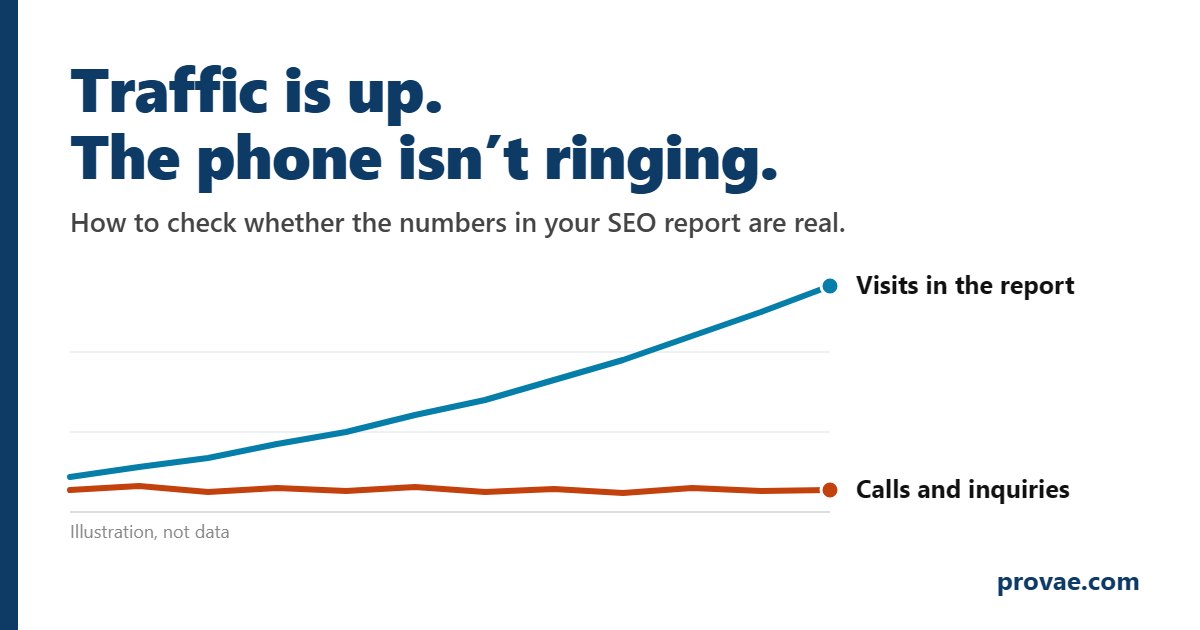
Every month a report arrives. The line goes up. Sessions are up eighteen percent, users are up twenty-two. And the phone is not ringing any more than it did last year.
At some point an owner in that position wonders whether the numbers are real. It feels like an ugly thing to think about a company you hired, so most people never ask it out loud. They should. It is a fair question, and unlike most questions about SEO, it has an answer that can be checked.
This article explains how website traffic gets inflated, why the report in your inbox cannot settle the matter, what you can check yourself for nothing, and where the one record that nobody can dress up is kept.
Most of the time it is not fraud
Start with the honest part. Deliberately faked traffic is not the usual explanation for numbers that go up while business stays flat. The usual explanations are duller.
- Bots counted as people. A large share of all web traffic is automated: crawlers, scanners, scrapers, monitoring services. Analytics tools filter some of it and miss a good deal.
- Traffic that is real and worthless. Visitors from other countries reading a blog post that has nothing to do with what you sell.
- Reporting that picks its window. This month against the worst month of last year.
- Your own staff and your own vendor. People checking the site every day are sessions too.
There is a fifth explanation, and it is the blunt one. Some companies selling SEO never learned the craft. They are collecting a monthly check, sending a report, and doing little that anyone could point to. No fraud is needed for that. The chart still has to go somewhere, and bot traffic lifts it for free.
None of that is a crime. All of it produces a rising line with nothing behind it. So the more useful question is wider than fraud: how much of the traffic you are being shown is people who could ever become customers?
How website traffic gets inflated on purpose
It does happen, and it is not difficult. Traffic can be bought. There are services that will send thousands of visits to any address for a few dollars, and they exist precisely because a rising chart keeps a client paying.
Manufactured traffic tends to take one of three shapes.
The burst. A page receives a large number of visits in a short time, often just before a reporting date. Crude, and easy to spot.
The trickle. A small, steady number of visits spread across many pages and many addresses, rising a little each week. This is the careful version. It is designed to look like growth, and inside an analytics dashboard it does.
The borrowed name. Visits that announce themselves as a search engine’s crawler or as an ordinary browser when they are neither.
What all three have in common is that they are aimed at the dashboard. They are built to move the number an owner is shown. They are not built to survive a look at the raw record underneath.
Why the monthly report cannot answer the question
Think about where each piece of evidence comes from.
| Source | Who controls what you see |
|---|---|
| The agency’s monthly report | The agency |
| The agency’s dashboard | The agency |
| Analytics | Whoever set it up and chose the filters, often the agency |
| Google Search Console | Google, though it only shows search |
| Your server’s access log | Your server |
The first three are presentations. That does not make them false. It means the party being judged is also the party preparing the evidence. How to read an SEO report covers what a report should and should not be trusted for.
The last one is different in kind. Your server writes a line for every request it receives: the address it came from, the time to the second, what was asked for, what was answered, and what the visitor claimed to be. Nobody at an agency writes that file. It is the one record in the whole relationship that the vendor did not prepare.
What you can check yourself, for free
Before anyone reads a log, there are five checks an owner can do in an afternoon.
- Compare traffic with Search Console clicks. If you are told organic search traffic rose by five hundred visits and Search Console shows clicks rising by forty, something other than search is supplying the difference.
- Look at where the visitors are. A plumber in Georgia has no use for a surge from another continent. Analytics shows visits by country and city.
- Look at what they did. Real people read, scroll, click a second page, look for a phone number. Sessions that last zero seconds and touch one page, by the hundred, are not customers.
- Look at the clock. People visit in the daytime and less at night, more on weekdays or more on weekends depending on the trade. Traffic that arrives at the same rate at three in the morning as at three in the afternoon is not people.
- Look at the phone. Calls, forms, direction requests, sales. If traffic doubled and none of those moved, the new traffic was not buying. Traffic and visibility are different things, and neither is revenue.
Any one of these can have an innocent explanation. Three of them together is a pattern worth an answer.
What the server log shows that a dashboard cannot
A log is long and dull, and that is its strength. Read properly, it separates visitors in ways no dashboard does.
Whether a browser was really there. When a person opens a page, their browser also fetches the images, the styles and the scripts that page needs. A real visit leaves a small cluster of requests. A script asking for the page alone leaves one line.
Whether a search crawler is who it says it is. Anything can call itself Googlebot. A genuine one comes from an address that traces back to Google. The log holds the address, so the claim can be tested.
Whether the timing is human. People pause. Machines request pages at intervals no hand could manage.
Whether the traffic is lumpy. Real audiences are uneven. A few addresses visit often, most visit once, and busy hours follow quiet ones. Traffic spread perfectly evenly across many addresses is a shape that real audiences do not make.
Whether search engines are doing real work on the site. This is the hopeful half. The same log shows which pages Google and Bing actually fetched and how often. Steady crawling of your real pages is a sign that something good is coming, whatever this month’s visitor count says.
The honest output of all this is not a single number. It is a range: at least this many visits behaved like people, at most this many could have been. A report that gives one confident figure for “real visitors” is claiming more than a log can prove.
How to get your own log
You do not need your SEO company’s permission, and you do not need to tell them. The log belongs to your hosting account.
In most hosting control panels there is a section called Raw Access, Raw Access Logs, or simply Logs. It offers a compressed file for each domain, sometimes one per day and one per month. Download it. That is all.
One caution matters more than the rest: hosts do not keep these for long. Many hold a few weeks, some only days, unless archiving is switched on. If you think you may want this question answered, download the files now and turn archiving on. Reading your logs every day explains what the lines mean.
What to do with the answer
If the traffic turns out to be real and simply unproductive, that is a conversation about targeting, and it is worth having calmly. Pages can be aimed at the wrong searches by people acting in complete good faith.
If the numbers do not hold up, ask before you accuse. Put the specific figures side by side — what the report said, what the log recorded — and ask the company to explain the difference. There may be an explanation. A straight answer to a specific question tells you a great deal about who you hired, and so does the absence of one. How to tell honest SEO work from the other kind lists the other signs to weigh alongside it.
Either way, you will be deciding from a record instead of from a feeling.
The evidence exists, and it can be produced
This is not a matter of one opinion against another. Whether the visits in a report were people, machines, or purchased traffic is recorded line by line in the client’s own server log, with the address and the time of every request.
ProVAE can produce that evidence. From the log it can show how many visits behaved like people, which ones claimed to be a search engine and were not, and where traffic arrived in a pattern no real audience makes. It is set out as data, with the lines it came from, so anyone can check it.
A steady rise is a schedule, and a schedule is a program. People do not arrive on a timetable. A real audience has a busy Tuesday and a dead Sunday, one page that takes off and nine that do not. When visits come in bursts and the number of pages touched climbs by a regular step, week after week, something is following instructions. Nobody’s customers behave that way.
A program does not start itself. Someone set it running. So the question an investigator would ask is the one worth asking here: who benefits when the chart goes up? Not a competitor, who gains nothing from making your numbers look better. Not a stray bot, which has no interest in your reporting date. The timing is in the log as well: when the pattern began, whether it peaks before each monthly report, and whether it stops when a contract ends.
One limit, stated plainly: a log shows what the traffic was. It does not, by itself, show who sent it. That is why the next step is a question put to the company, with the figures in hand.
Any firm padding a client’s numbers should understand the position it is in. The record exists. It belongs to the client. And it can be read.
A number you never need to take on trust
Most of what an SEO company tells you has to be taken partly on faith, because you cannot see what a search engine sees. Traffic is the exception. Your own server recorded it, independently, as it happened. An owner who knows that file exists is very hard to mislead with a chart.
A plain request
Everything on this site is free to read. Come and use it. The articles explain how to check your own numbers, how to tell whether a site was hacked, what SEO should cost, and what to ask before you sign anything. You do not have to give a name or an email address to read any of it, and none of it was written to trap you into a sale.
If you read it and can handle the problem yourself, good. That is what it is for.
If you want my help, or need it, contact me. I will tell you what I can see, what I cannot, and whether it is worth paying anyone, including me.
And if the larger question is whether your site can be found at all, the Free Visibility Snapshot shows what Google sees on your site today, with no agency in between.
See what Google seesFree · the Free Visibility Snapshot™ · a narrow look at four signals, not an audit
ProVAE is a local SEO company in Douglas, Georgia, serving South Georgia.